Why Google Reviews Matter More Than Ever
If you run a local business in 2026 and you're not actively building your Google review count, you're losing customers to competitors who are. It's that simple.
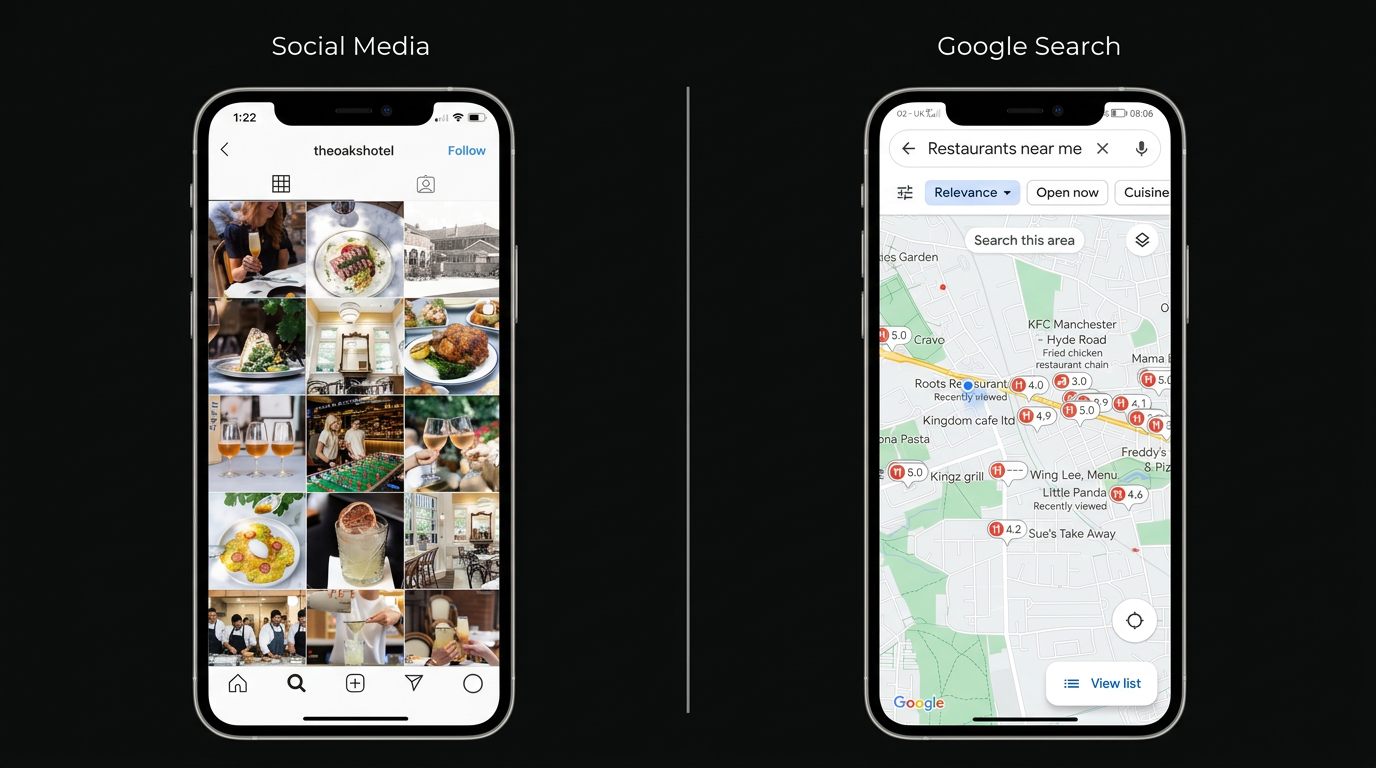
Google reviews aren't just social proof anymore. They're a ranking signal. The businesses that dominate the Google Maps top 3 — the listings that capture nearly half of all local search clicks — almost always have significantly more reviews than everyone below them. More reviews means higher ranking. Higher ranking means more visibility. More visibility means more customers. And more customers, if you have the right system in place, means more reviews.
It compounds. But only if you start.
The Review Gap Problem
Here's a scenario that plays out in almost every town and city across the UK, in almost every local business category.
Two dentists, half a mile apart. Similar prices. Similar quality. Both have been trading for years. One has 94 Google reviews and a 4.8 star rating. The other has 17 reviews and a 4.6 star rating.
The one with 94 reviews ranks in the Google Maps top 3. The one with 17 doesn't appear until page 2. The one with 94 reviews gets the majority of new patient enquiries from Google search. The one with 17 wonders why their website isn't converting.
The quality difference between those two practices is probably minimal. The review difference is everything.
Why Asking Manually Doesn't Work
Every business owner knows they should ask for reviews. Most try, at least occasionally. And most find the same thing — it rarely leads to a review actually being left.
Here's why.
- •The timing is wrong. You ask at the end of an appointment, or when handing over a job. The customer is thinking about getting home, not about leaving a review. They mean to do it later. Later never comes.
- •The friction is too high. Leaving a Google review requires finding your listing, logging into a Google account, clicking through to the review section, and writing something. That's four or five steps. Each step is an opportunity to abandon the process.
- •The ask feels awkward. Most people find it uncomfortable to ask for reviews face to face. They soften the request, mumble something about "if you get a chance," and the customer picks up the lack of confidence and doesn't prioritise it.
The System That Actually Works
The businesses that build review counts consistently — 15 to 20 new reviews every month, month after month — don't rely on manual asking. They use an automated system that does three things differently.
1. It asks at the right moment.
The optimal time to ask for a review is within two hours of a positive experience — while the customer is still feeling good about you, still has their phone in their hand, and the interaction is fresh in their mind. Not at the point of sale. Not a week later in an email they'll ignore.
An automated system sends the review request via SMS at exactly this moment, triggered by the completion of an appointment, a job, or a transaction. The customer receives a text while they're still in that positive emotional state. The conversion rate from this timing is dramatically higher than any other method.
2. It reduces friction to almost zero.
A good review request doesn't ask the customer to find your Google listing themselves. It sends them a direct link. One tap and they're on your review page, ready to leave a star rating and a comment. The fewer steps between the request and the review, the higher the completion rate.
3. It asks for feedback as well as reviews.
This is the part most businesses overlook, and it's one of the most valuable elements of the whole system.
Every customer is invited to leave a Google review. Alongside that, the system gives them an easy way to send feedback directly to you, so you hear about any problems quickly and can put things right for that customer.
Your Google review count grows steadily. Problems reach you quickly. Your reputation keeps improving.
What 50 Reviews Actually Does For Your Business
The impact of building your review count from, say, 14 to 50 is not linear. It's not just that you look more trustworthy to individual customers — though you do. The compounding effects run deeper.
- •Your Google Maps ranking improves. Google uses review count, recency, and star rating as ranking factors. More reviews, posted consistently over time, signal to Google that your business is active, trusted, and relevant. That improved ranking puts you in front of more searchers, which brings more customers, which generates more reviews.
- •Your conversion rate goes up without changing anything else. A customer who finds two plumbers on Google and sees one has 11 reviews and one has 67 reviews will call the one with 67 reviews first. Every time. Same prices, same location, same services — more reviews wins.
- •Your paid advertising gets more efficient. If you run Google Ads, a higher-reviewed business listing gets a better Quality Score, which means a lower cost per click for the same ad position. Your review count is literally reducing your advertising costs.
- •Your word of mouth accelerates. Trust is contagious. A business with 80 five-star reviews looks like the obvious choice to a new customer. That obviousness spreads. People recommend you more confidently because the social proof backs them up.
The Consistency Principle
One review a month won't move the needle. Ten reviews in a single week and then nothing for two months won't either — in fact, a sudden spike followed by silence can look suspicious to Google's algorithm.
What works is consistency. A steady flow of new reviews, arriving regularly, over an extended period of time. This signals to Google that your business is consistently delivering good experiences. It builds the kind of review profile that competitors can't easily replicate, even if they decide to start asking for reviews tomorrow.
Our clients who run review automation consistently add 15 to 20 new reviews every month. After six months that's 90 to 120 reviews. After twelve months, 180 to 240. At that point, the gap between you and your competitors becomes so large that new customers don't seriously consider anyone else.
What About Fake Reviews?
A question worth addressing directly because it comes up often.
Buying fake Google reviews is against Google's terms of service and the practice has become significantly harder as Google's detection has improved. Fake reviews get removed, accounts get penalised, and in some cases businesses have seen their entire review profile wiped.
Common Questions
Can I ask past customers for reviews?
Yes — and this is often where the biggest early wins come from. If you have a customer database going back months or years, a single well-timed reactivation campaign to that list can generate dozens of reviews in a short period. Customers who bought from you two years ago and had a great experience are often happy to leave a review — they just never thought to do it unprompted.
What if I get a negative review?
Negative reviews happen to every business. When one appears, the best response is a calm, professional reply that acknowledges the concern and offers to resolve it. A well-handled negative review can actually increase trust because it shows you're listening and responsive. The worst thing you can do is ignore it or respond defensively.
How many reviews do I need?
There's no magic number, but in most local markets, 50 reviews puts you in a strong position for visibility and conversion. In competitive markets like central London or large city centres, you may need 100 or more to stand out. The goal is always to have more than your nearest competitor and to be adding to that count consistently.
Does the star rating matter as much as the count?
Both matter, but count has more impact on ranking while rating has more impact on conversion. A business with 80 reviews at 4.6 stars will typically outperform a business with 12 reviews at 5.0 stars — both in Google rankings and in the number of customers who actually choose to call.
The Free Trial
We offer a free 14-day review boost trial because we're confident that once you see what automated review generation looks like in practice, the decision to continue becomes obvious.
Here's how it works. You send us your customer list — names and either mobile numbers or email addresses. We set up the automation, send the review requests at the right moment, handle the filtering, and report back on the results. Within 48 hours, new five-star reviews start appearing on your Google listing. By day 14, most businesses have added 10 to 20 new reviews without lifting a finger.
No card. No contract. No catch. If you see no value, you keep every review and walk away.
The worst that happens is your Google listing looks significantly better than it did two weeks ago.
Ready to find out what your review count could look like in 14 days? Start your free trial — no card, no contract, results in 48 hours.